
Quick answer
What is an entrepreneurial mindset?
An entrepreneurial mindset is the habit of seeing problems as opportunities, taking ownership of results and acting before you feel ready. It is built, not inherited: through small daily decisions, learning from failure, and refusing to wait for anyone's approval before you start building something of value.
The framework
The Unapproved Advantage
The Unapproved Advantage is the idea that being told no — by a bank, a boss or an investor — is not a stop sign. It's a head start. People who build without approval develop the skills, resourcefulness and resilience that approval would never have taught them.
- 1.Name the approval you're waiting for — a loan, a title, a yes from family.
- 2.Ask what you could build this week if that approval never came.
- 3.Do that first. Approval tends to follow motion, not the other way around.
What is an entrepreneurial mindset?
Most definitions make it sound mystical — a gift some people are born with. It isn't. An entrepreneurial mindset is a set of default responses. When something breaks, do you look for who to blame or for what to fix? When you see a gap in the market, do you think "someone should do that" or "I could do that"?
Those defaults are learned. They come from what you've practiced. That's good news, because anything learned can be retrained.
- Ownership — you treat outcomes as yours to change, not things that happen to you.
- Resourcefulness — you start with what you have instead of what you lack.
- Bias to action — you'd rather test an idea for $50 than debate it for six months.
- Long-term thinking — you'll trade comfort now for freedom later.
- Resilience — you see a no as information, not a verdict.
Why most people never develop it
The biggest enemy isn't fear. It's waiting. People wait for the right time, the right amount of money, the right connection or the right feeling of confidence. None of those arrive on schedule.
In my book I call this the approval trap. We grow up getting graded, hired, promoted and approved by other people, so we assume building a business works the same way. It doesn't. Nobody is going to hand you a hall pass.
Approval is usually the reward for having started — not the requirement to start.
I started my first business at 25, designing high-ticket websites, with no playbook. I learned by talking to people, hearing no, and adjusting. Nobody signed off on that. I just kept going.
The five beliefs founders operate from
1. Believe before you become
You have to see yourself as a builder before the results prove it. Identity drives behavior: people who think of themselves as "someone who finishes things" finish more things.
2. Your brain finds what you tell it to look for
Your brain filters out most of what's around you. Write your goals down and review them daily, and you'll start noticing opportunities that were always there. That's not magic — it's attention.
3. You already know enough to start
The 40% Rule: if you have about 40% of the information, you have enough to take the next step. Waiting for 100% means waiting forever, because the missing 60% only shows up after you move.
4. Failure is tuition
Every business I've built taught me something the previous one cost me. If you learn the lesson, the failure was an investment. If you don't, it was just a loss.
5. Never ask how — ask what's next
"How will this ever work?" freezes you. "What's the next step?" moves you. You rarely see the whole road; you only need the next ten feet.
Daily practices that build the mindset
Mindset gets built in small, boring reps. Here's what actually moves it:
- Write your top goal every morning — by hand, in one sentence. It keeps your filter pointed in the right direction.
- Do one needle-mover before anything else — the task that would make the day a win even if nothing else happened.
- Keep promises to yourself — confidence is just evidence you can trust yourself. Small kept promises add up.
- Review the week every Sunday — what worked, what didn't, what's next.
- Feed your mind on purpose — books, mentors and rooms that stretch you.
Common obstacles (and how to get past them)
Decision paralysis
Set a deadline for the decision and pick the option that's easiest to reverse. Most decisions are two-way doors.
Comparison
You're comparing your chapter 2 to someone else's chapter 20. Measure yourself against who you were 90 days ago.
Motivation fades
It always does. That's why discipline matters more. Build routines that run on schedule, not on mood.
Discouragement after a no
Ask what the no taught you. Then ask for the next yes. Volume beats perfection in the early years.
Do this this week
- Write down one approval you've been waiting on and one thing you'll build anyway.
- Pick one idea and spend 30 minutes testing it — a post, a call, a sketch of an offer.
- Choose a daily needle-mover and do it before email for five days.
- Run the Business Idea Scorecard on your best idea.
Free tool
Score your business idea →Key takeaways
- An entrepreneurial mindset is a set of learned defaults, not a personality type.
- Waiting for approval is the most common reason people never start.
- You need about 40% of the information to take the next step.
- Failure is tuition when you take the lesson with you.
- Daily reps — goals, one needle-mover, kept promises — build the mindset over time.
Frequently asked questions
Can you learn an entrepreneurial mindset?
Yes. It's built through repeated choices: taking ownership, acting on incomplete information and learning from results. Small daily practices compound into a new default.
What are the key traits of an entrepreneurial mindset?
Ownership, resourcefulness, a bias to action, long-term thinking and resilience. Most founders weren't born with all five; they built them through practice.
Do you need money to think like an entrepreneur?
No. Mindset comes first, and plenty of businesses start with skills and time rather than capital. See the guide on starting a business with no money.
How long does it take to change your mindset?
You'll notice a difference within a few weeks of consistent daily practice, but it's a lifelong process. Aim for progress you can see every 90 days.
Related articles
- Nobody Is Coming to Approve You. Start Anyway.
- Why You Keep Missing Opportunities (and How to Retrain Your Brain)
- The 40% Rule: Why You Already Know Enough to Start
- Comfortable but Stuck: How to Escape a Life That's Just 'Fine'
- Fell Off? The 'Never Miss Twice' Rule Will Get You Back
- People Follow People: How to Build a Founder Brand Without Being Cringe

About Joshua Corley
Entrepreneur, investor and author of The Unapproved Advantage. Joshua started his first business at 25 designing high-ticket websites, has built 25+ digital products and founded Remove Credit.
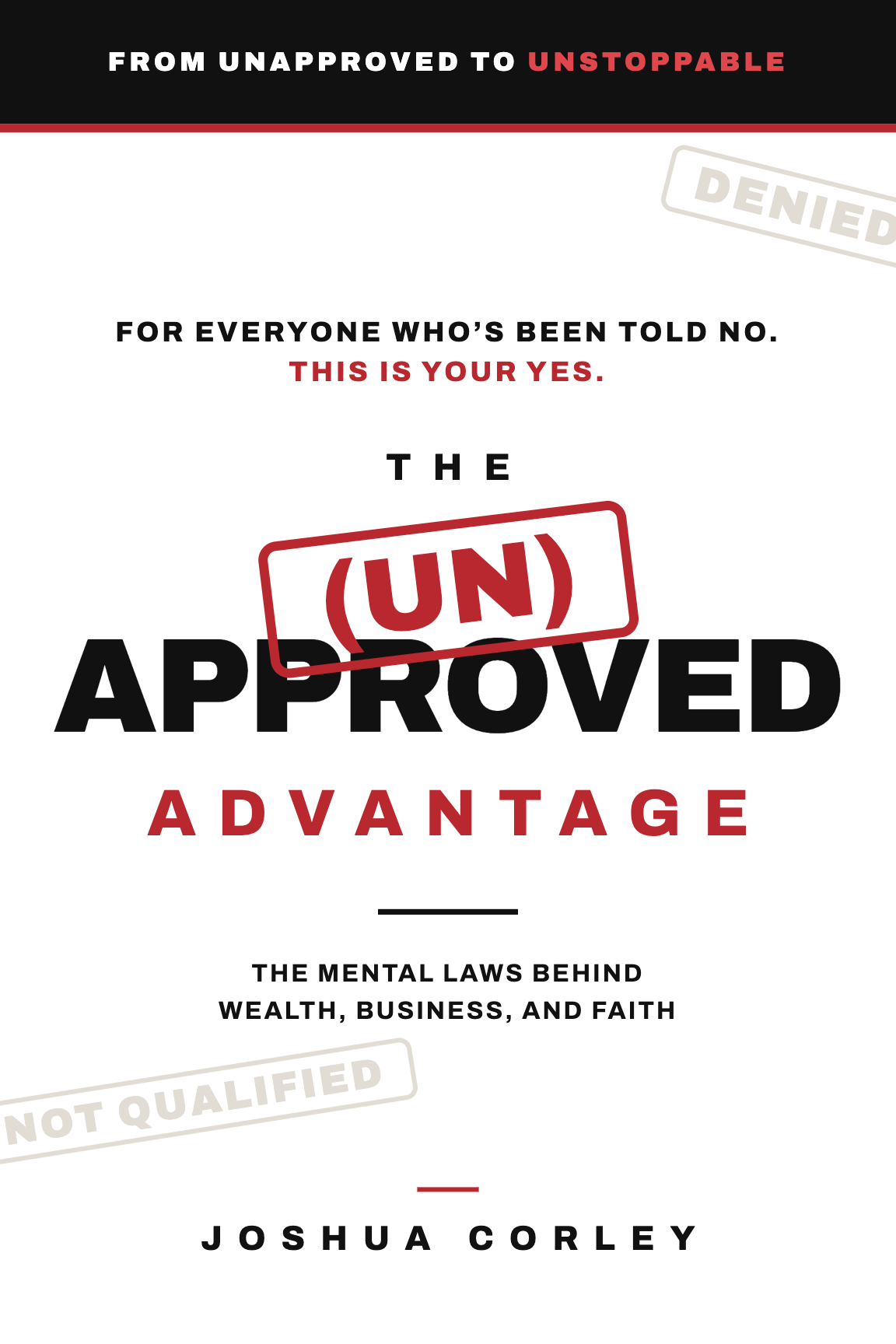
From the book
The Unapproved Advantage
The Mental Laws Behind Wealth, Business, And Faith
The mental laws behind every guide, in full.
Explore the book